October 8th, 2026Griffith University student named Rhodes Scholar
Griffith University medical student Ryo Takamizawa has been named Queensland’s 2027 Rhodes Scholar.
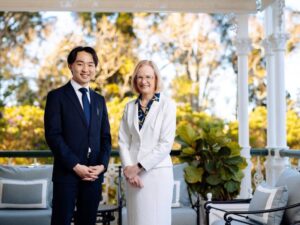
Governor of Queensland and Chair of the Rhodes selection panel Dr Jeannette Young, pictured with Mr Takamizawa, announced the award at Government House in Brisbane.
Mr Takamizawa, 24, graduated with a Bachelor of Medical Science in 2022 and is due to complete a Doctor of Medicine in November 2026.
He ranked first in a cohort of 220 students in 2025, received a Sir Samuel Griffith Medical Scholarship and consecutive Griffith Awards for Academic Excellence. He is currently working as a researcher in Griffith University’s Public Health and Economics Modelling Group and as a tutor in anatomy.
Mr Takamizawa will use his Rhodes Scholarship to undertake a Master of Science in Health Service Improvement and Evaluation. “My mission is to help build Australian primary care that protects a person’s place in their community,” he said. “We have never been better at saving people from disease, but far less adept at preserving a person’s place within it.”
Mr Takamizawa said his GP placement in rural Queensland further inspired him to advocate for chronically ill patients. “I want to design and evaluate a risk-adjusted blended funding model for GP-led multidisciplinary care, paying for continuity to prevent deterioration,” he said.
“Medicare mostly pays a GP for each visit – I want to test paying them to look after you over time, with more support for those who need care most. My ambition is to make functional independence a funded responsibility of primary care, rather than an aspiration sustained by exceptional clinicians.”
Mr Takamizawa chairs the board of the Australian Medical Students’ Association and is an elected representative on the Griffith University Council.
Outside of academia, Mr Takamizawa is an accomplished musician, playing piano and cello. He founded the Aurum Health Orchestra, a community organisation of 60 musicians who perform for people in oncology, palliative-care and aged-care settings.
Mr Takamizawa said the scholarship would give him the skills needed to make lasting change in Australian public health. “Oxford’s Health Economics and Policy Evaluation Group specialises in evaluating primary-care policy and its outcomes.
“I could run analyses through the world’s largest primary-care database, while the department’s role as a WHO Collaborating Centre on Primary Health Care would help me distinguish what Australia can adapt from what it should not.”